
How To Use the Nucleus Research Value Matrix for ERP Vendors Comparison

by Oct 26, 2018Acumatica, Microsoft Dynamics0 comments

Making a short list of ERP vendors is one of the most important, yet time-consuming part of an ERP buying decision. Thankfully, there are tools to help. One such tool, is the Nucleus Research ERP Value Matrix. This ERP vendors comparison tool can be useful in finding vendors who are a match for your company’s current and future software needs. Released yearly by the analyst firm Nucleus Research, these documents cover not just ERP, but many other software types. So, whatever you are in the market for, there‘s likely a Value Matrix to help in your search.

As helpful as these ERP vendors comparison documents can be, they can also seem a little daunting at first glance. So, let’s go over everything you need to know about the Nucleus Research Value Matrix and how to use it to create your ERP vendor shortlist.

ERPs are Not One Size Fits All

One of the first things you’ll notice when you open one of these reports, is a chart that plots out each vendor in one of four quadrants. The chart’s vertical axis measures usability. The horizontal axis measures functionality. It’s easy to assume that the products in the top right quadrant are the best, since they have the highest usability and deepest functionality. But, it’s important to note, in this case, placement does not equal ranking. It is simply illustrates a vendor’s market position.So, as a first step in using the Value Matrix as an ERP vendors comparison tool, you must decide which quadrant best represents your company’s needs. Think about your:
  1. Functionality needs (simple, industry specific or somewhere between)
  2. Budget (software and training)
  3. Implementation timeline
  4. Technological capabilities

For example, a small startup buying their first ERP system most likely does not need all the functionality offered by systems listed in the top right corner of the Value Matrix. Nor would they have the budget to buy one. Instead, they’d probably be looking for something at a lower price point, faster to implement and easier to use.

Choose Your Quadrant
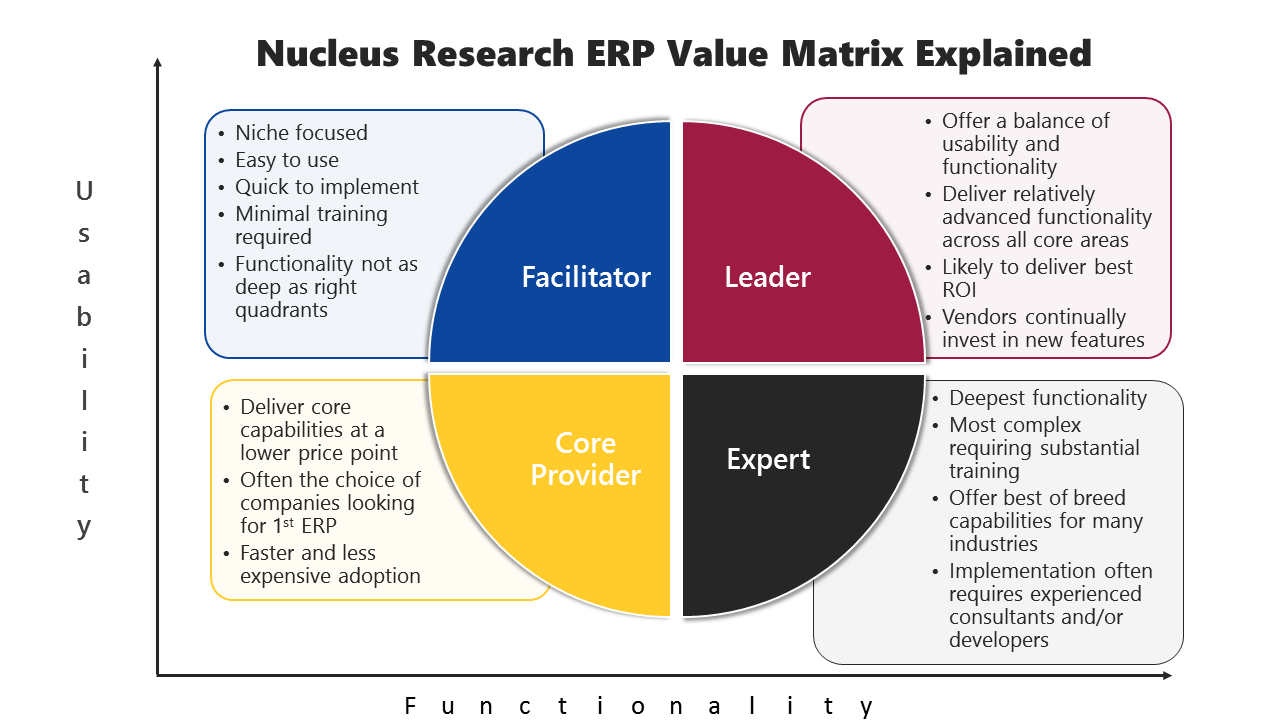
To decide which quadrant of this ERP vendors comparison tool your company fits into, consider the graphic below.
 

Want a printable version of the above graphic to refer to later or share with colleagues? No problem. Download it now.

Basically, core providers offer the lowest cost, simplest ERPs. Facilitator products are often more niche focused. But, they also deliver higher usability than those to their left. Leaders balance usability with features. And, Expert ERPs are for those needing best of breed, industry specific solutions.

Once you know which of these categories your business falls into, you can use the vendors shown in that quadrant as a jumping off point for building your shortlist.

Vendor Placement

Now you know functionality and usability are the two main factors Nucleus Research uses in developing its Value Matrix, you may think, “those are subjective criteria, how do they objectively measure them?”That is a great question. Nucleus Research scores each product on a scale of 1 to 10 for both factors. Then, they rebalance the average, so the systems scoring five in usability and five and functionality will be at the center of the matrix. Finally, the remaining systems are given places based on their score in each category.

Vendor Scoring

They base product scores on information gathered from these three sources.
  1. Interviews with current customers using each solution.
  2. Interviews with individuals who considered the solution being scored but chose another one instead.
  3. Nucleus Research analyst’s view of the solution based on demos and briefing.

With the Nucleus Research ERP Value Matrix now demystified, we’re sure you’re eager to see the latest edition. Download it here. We hope it’s helpful in your ERP vendors comparison efforts.

Then, when you’re ready, explore some of the most popular ERP options.

You may also enjoy

Cloud ERP for manufacturing: Acumatica vs. NetSuite production and costing questions to ask before you choose

Cloud ERP for manufacturing: Acumatica vs. NetSuite production and costing questions to ask before you choose

Evaluating Acumatica vs. NetSuite for manufacturing? The feature lists are similar. The differences emerge when you test real-world workflows. This guide explores the production costing, WIP reporting, scheduling, engineering change, and scalability questions manufacturers should ask before choosing a cloud ERP. Learn how to evaluate operational fit—not just functionality—to make a more informed ERP decision.

Data accuracy in SMB manufacturing The hidden cost of running without an ERP — and how Acumatica fixes it

Data accuracy in SMB manufacturing The hidden cost of running without an ERP — and how Acumatica fixes it

If your manufacturers data is messy, your ERP will be too. Bad BOMs, broken routings, and outdated revisions don’t fail quietly. They cause delays, rework, and lost revenue. This guide shows where “garbage in” starts, how it spreads, and how manufacturers clean their data before ERP go-live to avoid expensive mistakes and ongoing operational chaos.

Manufacturing ERP Demo Prep: 7 Questions Before You Sign

Manufacturing ERP Demo Prep: 7 Questions Before You Sign

A polished ERP demo can hide the risks that derail implementations: broken workflows, hidden costs, and integration gaps. These 7 manufacturing ERP demo questions reveal what’s really there. Use the included scorecard to compare vendors objectively, pressure-test every demo, and make a decision your team can defend with confidence.

Laura Schomaker

With over a decade of experience at Intelligent Technologies, Inc., I specialize in crafting educational content that demystifies the complex ERP buying process. From managing our digital presence to engaging with our community through blogs and email campaigns, my goal is to equip both current and future clients with the knowledge they need to make informed decisions.